

Blog / Frame
 Frame
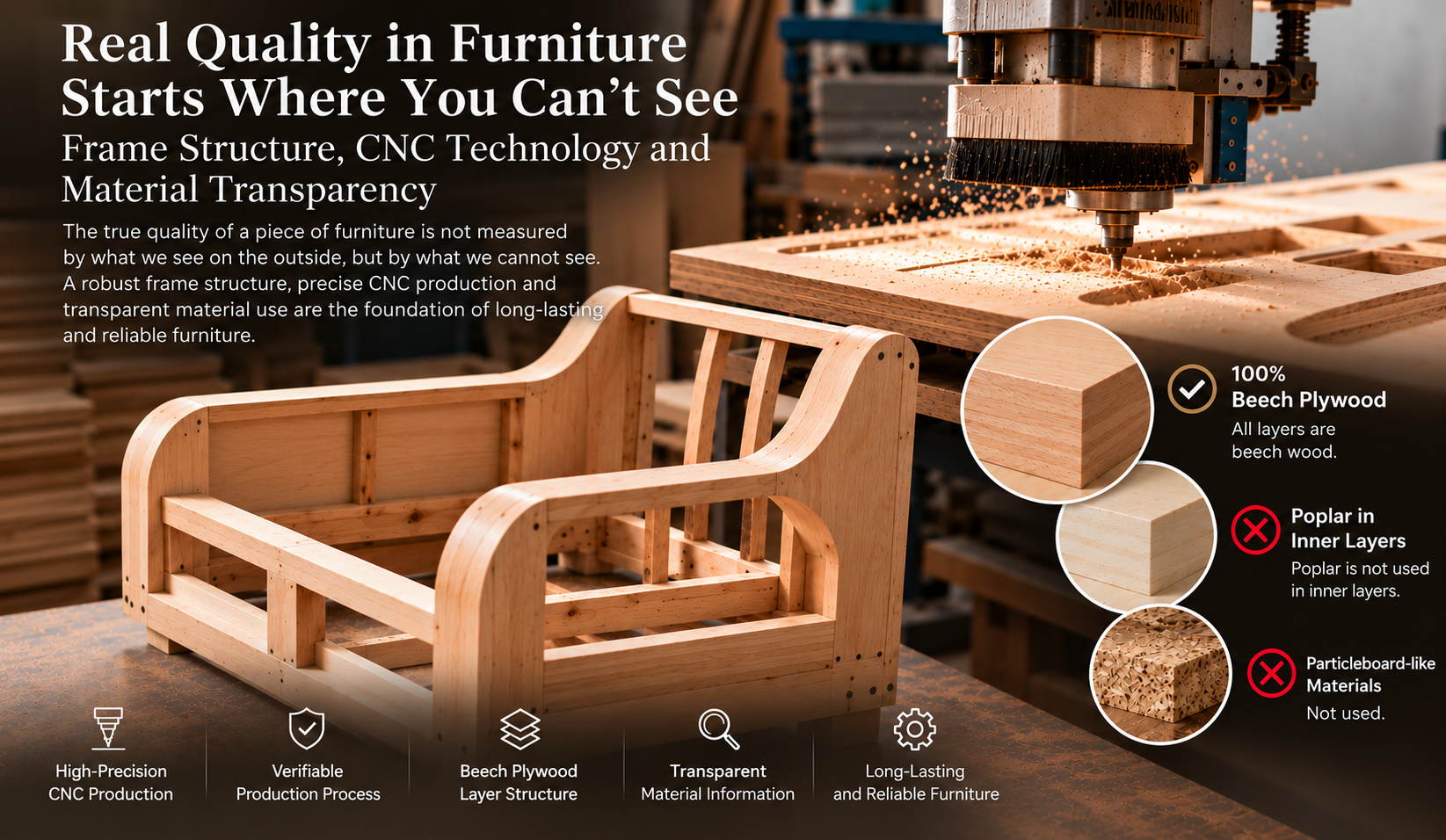
Real Furniture Quality: Frame Construction, CNC Technology, and Material Transparency
The true quality of furniture begins with its hidden frame structure. Discover why CNC manufacturing precision, verification of every layer of hornbeam plywood, and material transparency are essential.
The true quality of a piece of furniture is measured not by what we can see on the outside, but by what remains hidden.
When evaluating an armchair or sofa, we usually focus on its design, fabric, seating comfort, and aesthetic details. However, one of the most important factors determining whether it will retain its shape, strength, and reliability over the years is the frame structure concealed beneath the upholstery.
The frame is the structural support system of a piece of furniture. However, a high-quality frame should not be judged solely by how sturdy it appears. The actual properties of the materials used, the manufacturing method, dimensional precision, and the ability to verify all these factors are just as important as structural strength.
Because genuine quality should not merely be a claim; it should be a verifiable manufacturing standard.
1. Why Is CNC Technology Important in Furniture Frame Construction?
In modern furniture manufacturing, precision is one of the fundamental factors that determine quality.
Although human craftsmanship plays an important role in traditional cutting methods, small dimensional variations can occur when producing multiple copies of the same component. These variations may affect assembly accuracy and manufacturing consistency, particularly in armchair and sofa frames with complex geometries.
CNC (Computer Numerical Control) technology enables components to be manufactured according to predefined dimensions with a high degree of repeatability through computer-controlled cutting and machining processes.
The main advantages of CNC technology include:
- Dimensional precision: Helps ensure that frame components are cut according to technical drawings.
- Manufacturing consistency: Helps maintain similar dimensions and geometries across different production batches of the same model.
- Assembly accuracy: Reduces dimensional discrepancies at connection points.
- Design accuracy: Enables more controlled manufacturing of angled, curved, and complex frame components.
- Quality control: Makes it easier to inspect production through digital manufacturing files and measurement records.
However, there is an important distinction:
Claiming that CNC technology is used is not enough. Its use must be verifiable.
A manufacturer's statement that it uses CNC technology does not, by itself, prove that every frame component is CNC-machined or cut to the correct dimensions.
What matters is whether the following questions can be answered:
Which frame components are cut using CNC technology?
Are cutting operations performed according to approved technical drawings?
Are the dimensions of manufactured components inspected?
Are these inspections documented?
True manufacturing transparency is not simply about displaying machinery. It means making the manufacturing process and its results verifiable.
CNC technology is an important quality tool. However, without appropriate material selection, proper joint design, and effective quality control, it cannot guarantee a strong frame on its own.
2. Hornbeam Plywood: Are All Its Layers Really Made of Hornbeam?
Plywood used in furniture frames is an engineered wood panel manufactured by bonding multiple layers of wood veneer under appropriate adhesive and production conditions.
The performance of plywood is not determined solely by the appearance of its outer surfaces. The wood species, quality, arrangement, bonding strength, and manufacturing standards of its inner layers are equally important.
For materials marketed specifically as hornbeam plywood, an essential question must be asked:
Are all the wood layers in the panel actually made of hornbeam?
The presence of hornbeam on the outer surfaces of a plywood panel does not necessarily mean that its inner layers are also made of hornbeam.
Some plywood panels are manufactured using mixed constructions that combine different wood species. For example, the outer layers may be made of hornbeam, while the inner layers may contain other species, such as poplar.
Such mixed constructions are not necessarily inferior or unsuitable for use. However, they should not be presented as the same material as plywood made entirely from hornbeam layers.
Different wood species have different characteristics in terms of density, mechanical properties, and machinability. The final performance of a plywood panel depends on its overall construction and manufacturing quality.
More importantly, plywood and particleboard are not the same material. If particleboard-based components are used instead of plywood in a furniture frame, this should also be clearly disclosed.
Customers have the right to know which materials are used in the structural support system of the furniture they purchase.
3. What Matters Is the Internal Structure of the Material, Not Just Its Outer Surface
It is not always possible to determine with certainty which wood species have been used in every layer of a plywood panel simply by examining its surface.
Therefore, material verification should not be limited to visual inspection.
The following methods can be used for a reliable assessment:
Cross-sectional inspection: Examining the edge of a panel can reveal its layered structure and possible differences between layers. However, identifying the exact wood species of every layer based solely on color or grain appearance may not always be possible.
Manufacturer's technical documentation: Written information about wood species composition, layer structure, and product specifications can be requested from the panel manufacturer.
Supplier declarations and traceability: Records can be maintained showing the manufacturer, product description, and production batch associated with the purchased material.
Independent examination: When necessary, specialist laboratories can help identify wood species and verify material properties.
Mechanical performance testing: Strength and bonding-quality tests can be conducted according to relevant standards to assess whether the panel is suitable for its intended application.
The fundamental principle is clear:
The properties of a material should not be accepted solely on the basis of the seller's claims.
Particularly in the premium furniture segment, material specifications should be supported by documentation wherever possible and remain verifiable when necessary.
4. The Difference Between Cost Optimization and Material Transparency
Cost optimization is a natural and necessary part of manufacturing.
Using different materials is not inherently wrong. A manufacturer may choose different wood species or engineered wood panels, provided they meet the relevant design and engineering requirements.
What matters, however, is accurately communicating the materials used to the customer.
For example, if a manufacturer claims that an entire frame is made from hornbeam plywood, that claim must be consistent with the actual layer composition of the panels.
If a panel contains different wood species in its inner layers, it should be clearly identified as mixed-species plywood.
Similarly, if particleboard or other panel products are used in certain sections of the structural support system, this information should not be concealed.
Using different materials to reduce costs is not the same as using those materials while presenting the product as something else.
The first is a matter of engineering decisions and product positioning.
The second concerns the accuracy of product claims and customer trust.
5. What Should Genuine Quality Control Look Like?
Producing a high-quality furniture frame requires more than purchasing the right panels or owning CNC machinery.
The entire manufacturing process must be controlled.
The following stages are essential in a well-structured quality control system:
Incoming material inspection: The product description, thickness, physical condition, and supplier documentation of incoming panels should be examined.
Material verification: The composition of plywood claimed to consist entirely of a particular wood species should be verifiable using appropriate methods.
Digital cutting inspection: CNC programs should correspond to approved technical drawings, and critical dimensions should be checked.
Joint and assembly inspection: Frame joint design, fasteners, and assembly procedures should be evaluated.
Structural performance assessment: The completed frame or furniture product should meet the load-bearing and durability requirements appropriate to its intended use.
Manufacturing records: Material batches, cutting plans, and quality control results should be traceable and available for retrospective review when necessary.
This approach does more than help reduce manufacturing defects. It also increases the credibility of the quality claims made to customers.
6. Transparency: An Essential Standard in Premium Furniture
Premium furniture should not simply mean a product with a high price tag or an impressive appearance.
A genuine premium standard emerges from the combination of material quality, engineering, manufacturing precision, craftsmanship, and verifiable quality standards.
A furniture manufacturer should be able to clearly explain the materials and manufacturing methods it uses and respond to reasonable customer requests for verification.
For a frame described as CNC-manufactured, the extent of CNC use and the accuracy of its dimensions should be verifiable.
For a panel described as being made entirely of hornbeam plywood, it should be possible to verify whether the inner layers are genuinely made of hornbeam.
If different materials have been used, they should be clearly disclosed.
Transparency is not merely part of marketing communication. It is a foundation of quality management and long-term customer trust.
Conclusion: Questioning What Is Hidden Is the Key to Understanding True Quality
The fabric of an armchair or sofa can be replaced. Its upholstery can be renewed. Its exterior appearance can be changed over time.
But the frame remains the structural foundation of the furniture.
For this reason, choosing furniture requires attention not only to visible details but also to the manufacturing realities hidden beneath the surface.
Using CNC technology is important, but verifying that it is used correctly is even more important.
Choosing hornbeam plywood may be important, but it is essential to verify that the product actually has the declared layer composition.
Above all, one principle remains:
True quality has nothing to hide from transparency.
At Navelli, we believe that trust in furniture begins with a commitment to quality in which even the hidden details can be discussed openly.
Because, for us, quality is not only what you can see. It is also the confidence you can have in the manufacturing philosophy behind it.